Why fast riders still fall apart

Updated: Feb 26
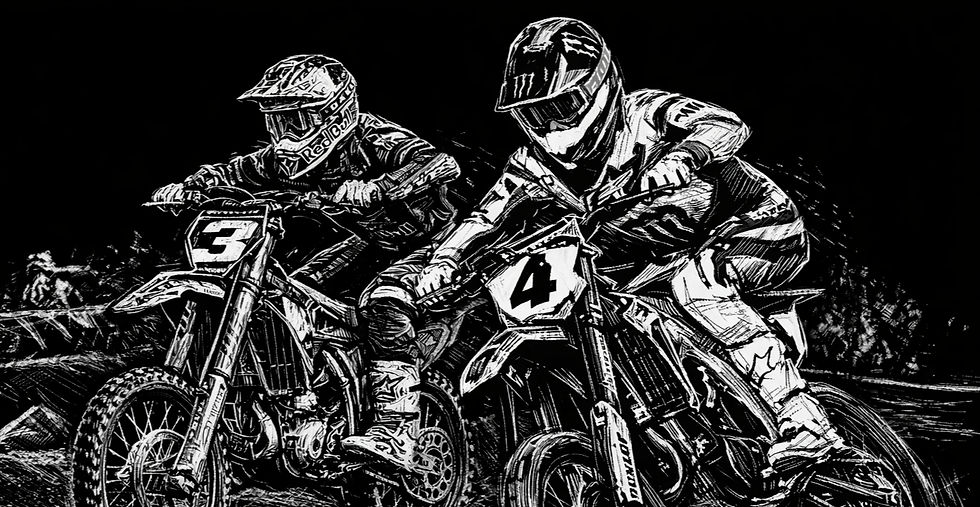
There is a certain type of elite rider the sport struggles to explain. On paper, nothing is missing. The speed is unquestionable. Technique looks clean and repeatable. Preparation is thorough. On the right day, the performance appears effortless and controlled. Yet the same rider can suffer sudden unforced crashes that seem to arrive without warning, sometimes even with a clear track and a comfortable lead.
What makes these moments difficult to understand is the absence of obvious triggers. The rider is not being pressured by competitors. There is no visible loss of control, no wild line choice, no sign of panic or over aggression. In the laps leading up to the mistake, the technique often looks correct and the pace sustainable. From the outside, nothing appears to be breaking down.
When this happens, the explanation usually shifts away from the rider and toward something tangible. Commentary and journalism look for a concrete cause. A bike issue is suggested. A setup change is highlighted. In more sensational cases, the moment is framed as a flaw in temperament or an inability to handle pressure. These interpretations are understandable. They provide clarity. They give the audience something visible to point to.
From inside the performance, however, the experience is more ambiguous. The motorcycle genuinely feels different. The rider is not inventing that sensation. What is rarely considered is that the change may not originate in the machine itself. A motorcycle is experienced through the riders internal regulatory state, and when that state shifts, the same bike and setup can feel fundamentally different without any mechanical regression.
Observers sometimes point to isolated symptoms. Vision appears shorter. Lines tighten. Timing looks rushed. These observations are accurate but incomplete. Vision does not collapse spontaneously. It narrows when the riders internal regulatory state destabilises and execution gives way to monitoring. When that shift occurs, reference points are lost, decisions arrive later, and the margin that once felt generous disappears without warning.
This is how a rider can be leading comfortably, riding alone, and still make a mistake that feels inexplicable. From the outside, it can look like an excuse or a mystery. From the inside, it feels like something subtle has gone missing. The issue is not that the rider forgot how to ride. It is that access to a stable internal regulatory state that previously allowed the performance to unfold cleanly has been disrupted. When that state is present, execution looks inevitable. When it is not, even flawless technique offers no protection.
Internal State and Adaptability
At the highest level, riders are not limited by what they know how to do. They are limited by how reliably they can access the conditions under which that ability expresses itself. Every rider operates through an internal regulatory state that governs perception, timing, and commitment. This state is not confidence in the conventional sense. It is the condition of the nervous system as it interacts with speed, threat, and consequence in real time.
When this state is stable, perception stays wide, decisions arrive early, and execution flows without supervision. When it destabilises, attention turns inward, perception narrows, and the same actions become harder to repeat. The important point is that this shift can occur without any visible change in lap time, technique, or effort. The rider may still look fast, yet something fundamental has changed in how they are operating.
This is where riders begin to diverge. Some unconsciously require a particular sensation before they allow full commitment. When it is present, they look exceptional. When it is not, execution becomes conditional. In these moments, the motorcycle becomes the reference point through which that permission is interpreted, meaning a change in internal regulatory state is often experienced as a change in the bike itself. Riders then search externally for what has gone missing, often through setup changes or adjustments in approach. The intention is not avoidance, but an attempt to regain access to the state that previously unlocked performance.
Other riders operate differently. They do not wait for alignment. They accept movement, discomfort, and imperfection as part of the task rather than as a signal that something is wrong. Their internal regulatory state remains relatively stable even when conditions change. As a result, perception stays open and timing remains early. They may not always look spectacular, but their performance does not collapse when variables shift.
This distinction is often misunderstood because it is not immediately visible. Both types of riders can be fast. Both can win races. The separation only becomes apparent over time, particularly under changing conditions. Riders who depend on a narrow internal window tend to show higher peaks and deeper troughs. Riders who tolerate a wider range of internal states maintain a higher baseline and make fewer unforced errors.
The consequences of this misunderstanding extend beyond lap times. Inside teams and families, the lack of language around internal regulatory state creates volatility. Mechanics search for mechanical causes. Team managers look for results. Parents look for certainty. When a riders feedback becomes vague or centred on machinery or conditions, the experience of something feeling different is often dismissed as excuses or labelled as being in their head.
For the rider, this is often where frustration and isolation begin. What they are experiencing is real but difficult to articulate. They are not lacking effort or belief. They are not mentally weak. Yet without a shared framework, the situation becomes binary. Either the rider has it or they do not. Either they can handle pressure or they cannot. Support tightens rather than expands, and confidence erodes not because the rider doubts their ability, but because no one can explain what is actually happening.
In developmental environments, this can be decisive. Contracts are questioned. Parents reconsider futures. Riders begin to internalise doubt that does not belong to them. Careers can pivot on whether this distinction is recognised early enough.
Why Speed Does Not Scale
The same mechanism explains a pattern seen across championships. Riders can dominate domestically, even outperform visiting international competitors on home soil, yet struggle when they step into global competition themselves. Domestic environments provide familiarity and identity security. The rider knows the tracks, the rhythms, the expectations. They are expressing themselves rather than proving themselves. Visiting riders, meanwhile, are adapting, often operating slightly off baseline.
This effect is even visible at individual circuits. When major events visit certain tracks, local riders will occasionally produce performances far beyond what their results elsewhere would predict. In the United States, this phenomenon is well known at places like Southwick. Riders who grew up racing that surface understand its movement intuitively. Their internal regulatory state remains settled, perception stays open, and decisions are made early. Visiting riders, by contrast, are negotiating the surface in real time. The difference is not courage or effort. It is who is operating from a stable internal position.
When the environment flips, so does the advantage. At international level, the reference group shifts. Expectations rise. Uncertainty increases. Comparison becomes unavoidable. Even without conscious pressure, the nervous system reads this as a different task. Internal regulatory state becomes less stable. Perception tightens. Speed does not disappear, but access to it becomes conditional.
This is why speed alone does not scale. Speed is not a fixed asset. It is an expression of the riders internal regulatory state. Riders whose performance depends on familiarity or reassurance can look dominant in narrow contexts and constrained outside them. Riders whose performance is built on tolerance rather than comfort tend to travel better. They do not need the environment to confirm them before they commit.
At the very top of the sport, this difference becomes unmistakable. The most complete riders are not defined by where they feel best. They are defined by how little their performance changes when everything else does. New tracks. Different soil. Unfamiliar rhythms. Different machinery. The external variables shift, but the internal process remains intact.
This adaptability becomes most visible when conditions deteriorate mid race. After a crash, with a bent lever, twisted controls, or a motorcycle that no longer feels neutral, many riders experience a sharp drop in execution. Not because they cannot continue, but because their commitment was tied to a specific feeling. More adaptable riders respond differently. They accept the new limitations immediately. The performance may no longer be ideal, but the intent remains unchanged. Even when peak performance is no longer available, peak commitment is.
This is why riders like Eli Tomac stand apart. Across manufacturers, track styles, and phases of his career, his defining quality has not been perfection but robustness. The bike moves. The track breaks down. The rhythm shifts. None of it requires negotiation. What is often described as beast mode is not reckless aggression, but commitment without reassurance. Vision stays wide. Timing stays early. Execution does not depend on comfort to survive.
Riders who adapt slowly can look exceptional in familiar settings and fragile outside them. Riders who adapt quickly carry their performance across tracks, championships, and eras. This is why some riders dominate locally but stall internationally, while others scale rapidly without ever appearing dominant at home.
The highest level of the sport does not reward those who need conditions to align. It rewards those who can align themselves with whatever conditions they are given. Until this distinction is properly understood, the sport will continue to misinterpret sudden crashes, inconsistent weekends, and fluctuating feedback as mysteries or excuses, and remain surprised when the fastest riders fall without an obvious cause.

Gary Linge is a high-performance motocross coach specialising in elite rider development, performance psychology, and identifying the hidden constraints that limit execution under pressure.


Comments